
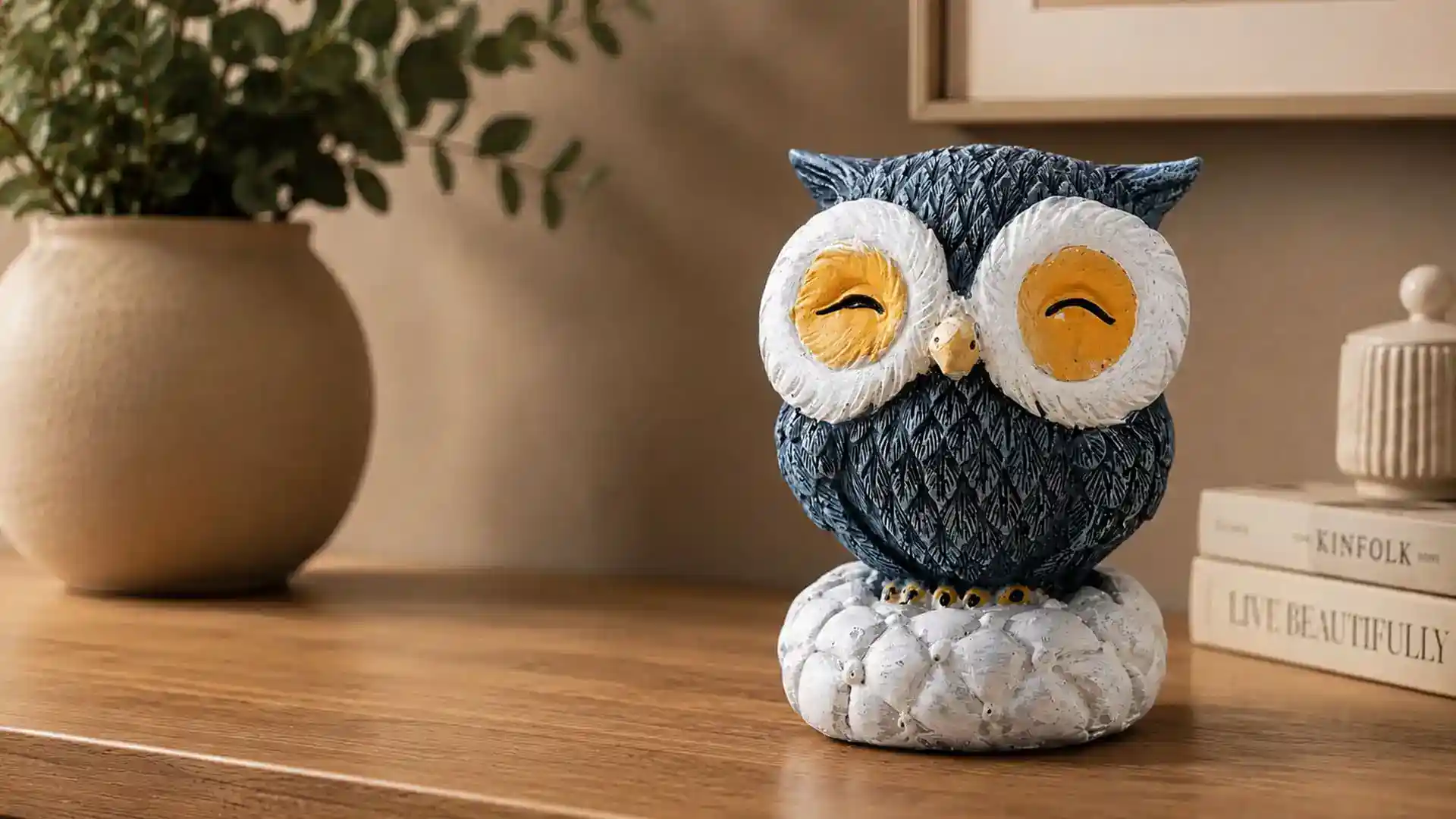
Any empty area can be transformed into a visually interesting part of your room with decorative items. Nevertheless, choosing a decorative item makes up only half the decorating process. The placement of the article can have just as much influence on the final result.
You may need to place a sculpture on the floor, if it disappears on a crowded shelf. On the other hand, small decorative bowl can look completely at home on a compact side surface, even though it feels insignificant on a large table.
Proportion, visibility, function, surrounding furniture, and available space must be considered for good placement. Instead of decorating every empty spot, think about what each area needs and which objects naturally belong there.
Start With the Floor
When an item has enough height, volume, or visual weight to stand independently, floor decoration can work particularly well. Unused corners can be occupied by tall vases, substantial sculptures, decorative baskets, large planters, floor lanterns, and similar pieces. They also soften transitions between different furniture pieces.
With these objects, you can also introduce interest at lower levels of a room, especially if much of the existing decoration is concentrated on walls and tables. Don’t simply put small accessories directly on the floor as there’s some empty space. They tend to easily become an obstacle and feel lost as well.
Floor pieces are required to be intentional and not forgotten. Position them where they complement the furniture without restricting any kind of movement an the room.
Use Corners for Taller Decorative Pieces
Standard furniture doesn’t always fit comfortably into corners. Thus, they frequently remain empty. They’re therefore considered to be useful locations for placing vertical decorative items. You can introduce visual height into an otherwise unused corner by placing a tall vase, sculptural piece, based, or even a decorative arrangement.
The main goal here should be to fill up the vertical emptiness without overcrowding the area even a bit. You must also consider the width along with the height of the object. A slimmer item is generally suited for a narrow corner. Contrarily, you can place an item with greater volume on a spacious corner.
Besides, another key component is lighting. Choose an object with a silhouette or surface that remains visible under available illumination, if the corner you’re decorating is dark.
Keep Coffee Table Decoration Low
In many seating arrangements, coffee tables have a central position. Therefore, when you place a decorative item there, it becomes highly visible. Nevertheless, these surfaces also have functional value.
The few decorative items that work well here include low bowls, trays, small sculptures, decorative objects, and compact arrangements. They help in adding visual interest without creating any unnecessary visual barrier at all.
Particular attention must be given to height. Sightlines are generally hindered by very tall accessories places across the seating area. This requires frequent repositioning. Rather than spreading numerous objects across the entire surface, try to create a compact arrangement. When you leave some open space, the table becomes even more practical and prevents your arrangement from looking crowded.
Several smaller items can also be visually connected using a tray. Besides, it becomes easier to relocate them when additional surface space is required.
Give Dining Tables Breathing Room
Generous surfaces are offered by dining tables, making it tempting to overdecorate such surfaces. A clear focal point can be established by a centerpiece, while not consuming the entire table. Moreover, depending on the size and shape of the furniture, this may include a vase, bowl, sculptural arrangement, or a small collection of coordinated objects as well.
Also, you must keep everyday functionality in mind. If your decoration is interfering with serving, seating, or conversation, then it ends up becoming quickly inconvenient. Arrangements can be spread horizontally in longer tables, whereas, smaller tables benefit from one concentrated centerpiece.
Preserve visible empty space around the decoration, as much as possible. This will ensure that your arrangement stands out and will keep the table ready for practical use as well.
Use Side Tables for Smaller Accents
For smaller decorative pieces, side tables are a useful location. Their limited dimension naturally suits compact objects. Here, small vases, candle holders, bowls, framed items, and sculptural accessories work particularly well.
Nevertheless, these tables must frequently accommodate functional objects, making restraint an important thing. Select one or two decorative elements that complement the proportion of your table, instead of filling the entire surface.
A small arrangement becomes even more interesting with height variation. You can create dimension without requiring numerous accessories, by pairing a slightly taller item with a lower object. Your end result should look intentional without leaving enough room for everyday use.
Consider Consoles as Display Zones
For more developed decorative arrangements, console tables provide excellent opportunities. Such tables are typically long and relatively narrow, allowing them to accommodate combinations of lamps, vases, sculptures, trays, framed objects, and smaller accessories as well.
Rather than strict symmetry, think about visual balance. One tall item on one side might be balanced by two or three smaller objects on the other. Consider the entire area as one composition, if artwork or another decorative feature hangs above the console.
The objects on the table should visually relate to what appears above them rather than competing with it. Leaving gaps between groups can prevent the display from becoming visually heavy.
Create Layers on Shelves
Ideal for displaying smaller decorative pieces, shelves tend to become visually cluttered when every available section is filled. Mix objects with different heights, shapes, and textures. Small sculptures tend to sit beside books, bowls can occupy lower spaces, and framed pieces can create vertical elements.
Another useful consideration is depth. Not every item needs to sit along the front edge. Position some objects slightly farther back to create visual layering.
Avoid making every shelf identical. Some sections can hold several small pieces, while others may feature one larger object. More importantly, allow empty areas to remain. Negative space gives individual pieces room to register visually.
Use Bookcases Without Filling Every Gap
Both practical and decorative purposes are served by book cases. When you combine books with accessories, it prevents them from looking overly uniform, while preserving their primary function. Break up long rows of books with decorative objects, while introducing contrasting shapes.
For example, you can create visual variation with a rounded bowl beside rectangular books.
Spacious shelves are suitable for larger objects, while smaller compartments are appropriate for compact accessories. If you’re repeating related colors, textures, or materials across different shelves, you can ensure that the entire bookshelf feels connected. The key aim here is visual rhythm and not maximum occupancy.
Place Decorative Items at Eye Level
We tend to naturally give more attention to objects placed near eye level. Shelves, wall-mounted ledges, cabinets, and display units at this height are therefore useful locations for pieces with intricate details or unusual textures.
Reserve these highly visible areas for items you particularly enjoy seeing. Smaller decorative objects can also benefit from eye-level placement because viewers can appreciate details that might disappear from a greater distance. However, avoid placing every striking item at exactly the same height. Variation keeps the eye moving naturally throughout the room and makes the overall arrangement more dynamic.
Match Placement to the Object's Visual Weight
Visual weight is not determined by physical weight alone. Dark colors, dense materials, bold shapes, and large dimensions can make an object appear heavier. Substantial decorative items usually need enough surrounding space to balance their presence. Lighter, smaller objects can fit comfortably into compact arrangements.
If an accessory feels awkward in one location, try moving it before deciding that it does not suit the room. A change in height, background, lighting, or surrounding space can dramatically alter its appearance.
Final Thoughts
Knowing where decorative items should go is ultimately about matching each object to the scale, purpose, and visual character of its surroundings. Large pieces can anchor floors and corners, compact accessories can bring detail to side tables, low arrangements can keep coffee tables functional, and shelves can provide layered displays for smaller objects. Consoles offer opportunities for broader compositions, while eye-level surfaces highlight pieces with details worth noticing.
There is no need to decorate every available area. Empty space plays an important role by giving individual objects greater visual presence.
Instead of asking where you can fit another decorative item, consider where that piece can contribute something meaningful. When scale, function, visibility, and spacing guide placement decisions, decorative objects can feel like intentional parts of the room rather than additions simply filling empty surfaces.